 06
06
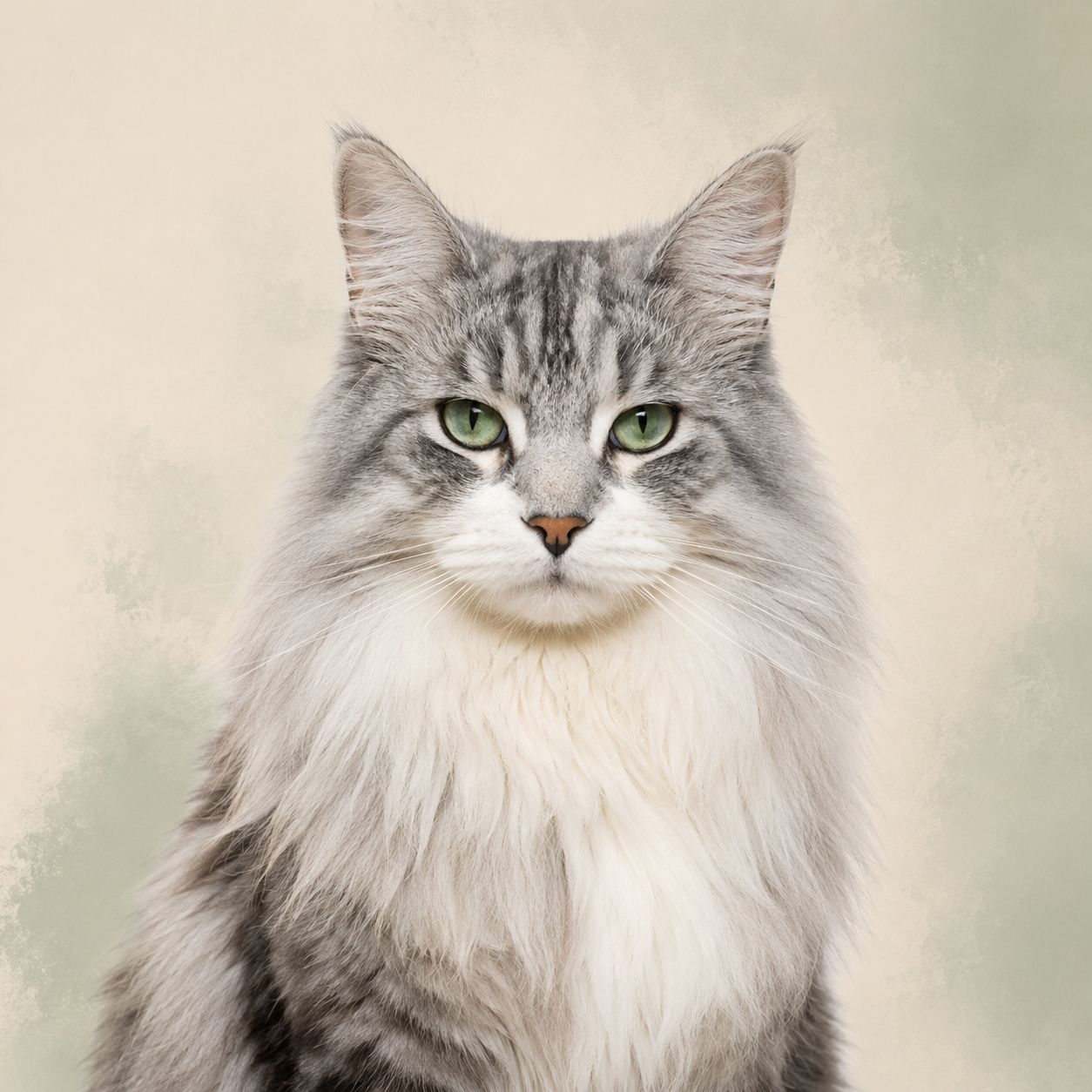
Ask a Norwegian breeder what they call their cats, and the word that comes back almost never has “Norwegian Forest” in it. It’s skog, meaning forest, and katt, meaning cat — said together, fast, the way a name gets said when nobody’s translating it for an outsider. Skogkatt is the original name for the animal the rest of the world came to know by its export title. In Norway, the word was never a breed designation. It was a description: the big, thick-coated cats living in the forests and on the farms of Scandinavia, long before anyone wrote a breed standard.
What Is a Skogkatt?
The word carries cultural weight that the international name never quite picked up. Call this cat a Skogkatt and you connect it directly to Norse mythology, to the Viking Age, to the specific stretch of Norwegian landscape that shaped it over centuries — a connection the English name simply doesn’t carry.
It’s the name used in Norwegian folk tales, in the Prose Edda’s mythological references, and in the original conservation efforts of the 1930s and 1970s that pulled the breed back from the edge.
→ Skogkatt: Meaning and Story of the Original Name
Skogkatt vs Norwegian Forest Cat
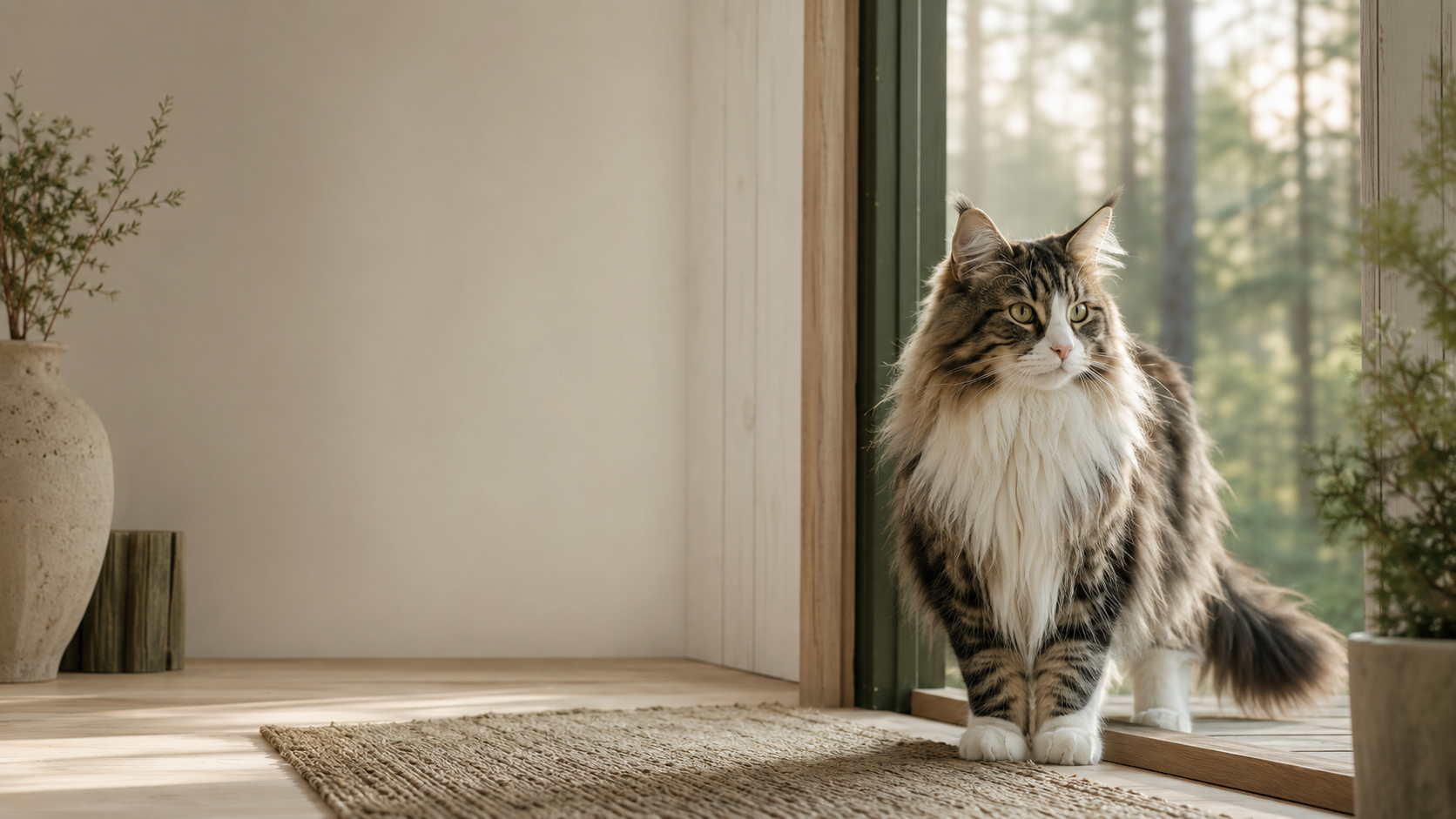
Same animal, two names. Skogkatt is the Norwegian one; Norwegian Forest Cat is the international breed name registered with FIFe, TICA, and CFA. The distinction matters culturally. Biologically, there isn’t one.
Other names you may encounter for the same breed:
- Wegie — informal English nickname, pronounced like “squeegee”
- Norsk Skogkatt — formal Norwegian name, used by FIFe and many European breeders
- Skaukatt — regional Norwegian variant spelling
- Huldrekatt — the name used in Norwegian folk tales, meaning “fairy cat” or “hidden cat”
- Norwegische Waldkatze — German name
- Chat des forêts norvégiennes — French name
→ Wegie Cat: Nicknames the Breed Carries Worldwide
Origins & History
The origins are debated, but the broad outline holds. The breed’s ancestors may have arrived in Norway around AD 1000, brought over by Vikings. Centuries in Norwegian forests and on Scandinavian farmsteads did the rest — natural selection, not a breeding program, produced a cat perfectly built for its environment.
By the early 20th century, urbanisation and crossbreeding with domestic shorthairs had pushed the breed close to extinction as a distinct type. A first conservation attempt in the 1930s was cut short by World War II. FIFe recognition followed in 1977. Two years later, the late King Olav V made it Norway’s national cat.
- Norwegian Forest Cat History and Origin
- Viking Cats: How Norwegians Sailed With This Breed
- Are Norwegian Forest Cats Wild? Ancestry Explained
Mythology & Folklore
No other domestic cat breed is written directly into Norse mythology. The Prose Edda, composed by Snorri Sturluson in the 13th century, describes the goddess Freya travelling in a chariot pulled by two large cats. Norse folklorists identify those cats as Skogkatts — the only large domestic cat native to Scandinavia when the stories were first told.
Separately, in folklore, it appears as the huldrekatt — a fairy or hidden cat that climbs sheer rock faces and vanishes into dense forest without a trace. Strip away the fairy tale, and that description lines up almost exactly with a real, documented ability of the modern NFC: head-first tree descent, made possible by rotating hind ankles found in no other domestic cat.
Physical Identity
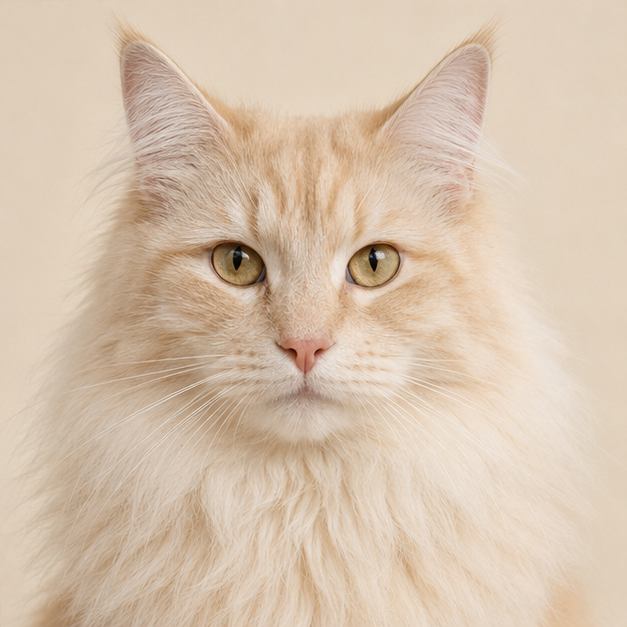
Nothing about this cat’s appearance is decorative. Every distinguishing feature solves a problem posed by centuries of Norwegian winter, functional first and photogenic second.
The double coat is a dense woolly undercoat for insulation under a long, water-repellent guard layer that sheds rain and snow. The triangular equilateral head, with its straight profile from brow to nose tip, is the most reliable visual identifier that separates this breed from similar ones — the Maine Coon especially.
The longer hind legs make head-first tree descent possible — a climbing manoeuvre that shows up in old folklore and holds up, exactly as described, under modern breed biology.
- Norwegian Forest Cat: Complete Breed Guide (2026)
- Norwegian Forest Cat Size: How Big Do They Get?
- Weight Chart by Age: Is Your Wegie on Track?
- Lynx Tips & Ear Tufts: Signature Features
- The Plumed Tail: A Norwegian Forest Cat Signature
- 25 Norwegian Forest Cat Facts That Surprise Owners
- Small Norwegian Forest Cat: Is Yours Undersized?
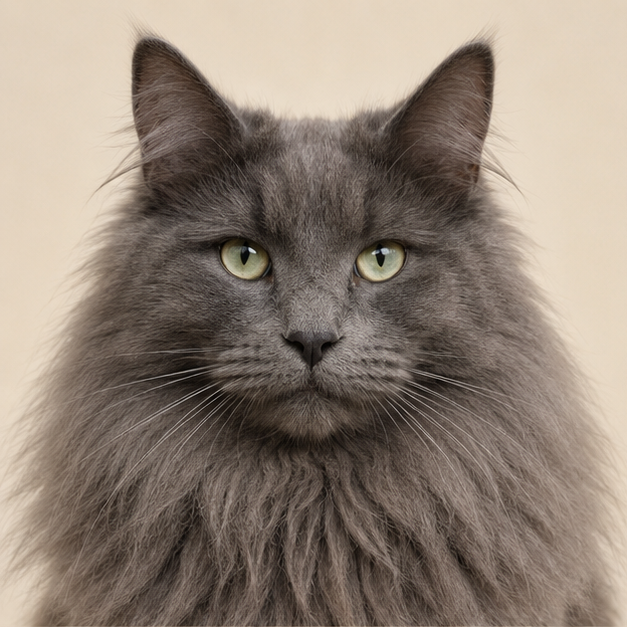
Norway’s National Cat
Few domestic cat breeds hold this kind of formal cultural status anywhere in the world. Royal recognition came in 1979, when King Olav V named it the official cat of Norway.
Today it ranks among the most popular breeds in Norway, France, and Sweden. In the 2024 FIFe statistics, it placed sixth most popular cat breed worldwide, at 4.3% of total registrations. Near-extinction in the 1940s to sixth most registered breed globally by 2024 — if you’re reading this because you’re considering one, that’s the conservation story you’re actually buying into, not just the cat.
- Are Norwegian Forest Cats Rare? Availability Map
- Norwegian Forest Cats at Cat Shows: Breed Standard
- What Owners Really Say: Reddit & Forum Honest Takes
Norwegian Forest Cat breed standard — FIFe →
Norsk Kattforening (NKF) — official Norwegian cat registry →
Audio, Video & Visual Guides
Every major topic in this Skogkatt guide has a matching audio, video, or visual resource.
Podcast Episodes
Video Guides
Infographics
17 articles about the Skogkatt — the name, the history, the mythology, the physical identity behind it.
Name & Identity
- Skogkatt: Meaning and Story of the Original Name
- Wegie Cat: Nicknames the Breed Carries Worldwide
- Norwegian Forest Cat: Complete Breed Guide (2026)
History & Origins
- Norwegian Forest Cat History and Origin
- Viking Cats: How Norwegians Sailed With This Breed
- Are Norwegian Forest Cats Wild? Ancestry Explained
Mythology & Folklore
Physical Identity
- Norwegian Forest Cat Size: How Big Do They Get?
- Weight Chart by Age: Is Your Wegie on Track?
- Lynx Tips & Ear Tufts: Signature Features
- The Plumed Tail: A Norwegian Forest Cat Signature
- 25 Norwegian Forest Cat Facts That Surprise Owners
- Small Norwegian Forest Cat: Is Yours Undersized?
Culture & Community
- Are Norwegian Forest Cats Rare? Availability Map
- Norwegian Forest Cats at Cat Shows: Breed Standard
- What Owners Really Say: Reddit & Forum Honest Takes
Browse all Breed Information articles →
Decisions that deserve a closer look
This section extends the published guide with practical questions readers face after the first answer. It keeps the broad Hub useful without replacing the focused articles linked throughout the page.
What the word Skogkatt actually means
The name joins the Norwegian words for forest and cat, but its cultural use carries more history than a literal translation. In this Skogkatt resource, the point is not to create another rule; it is to show which evidence changes the decision and which detail is only noise.
Use the answer as a checkpoint. Confirm documents where documents exist, observe the individual cat where behavior matters, and involve a veterinarian whenever health enters the question. The next useful action should be clear enough to take without turning a broad guide into a substitute for specialist advice.
Why the original name still matters
Using the original name connects modern breed identity with Norwegian language, landscape and preservation work. In this Skogkatt resource, the point is not to create another rule; it is to show which evidence changes the decision and which detail is only noise.
Use the answer as a checkpoint. Confirm documents where documents exist, observe the individual cat where behavior matters, and involve a veterinarian whenever health enters the question. The next useful action should be clear enough to take without turning a broad guide into a substitute for specialist advice.
What history can document
Breed history becomes stronger when dates, organizations and published records are separated from attractive legends. In this Skogkatt resource, the point is not to create another rule; it is to show which evidence changes the decision and which detail is only noise.
Use the answer as a checkpoint. Confirm documents where documents exist, observe the individual cat where behavior matters, and involve a veterinarian whenever health enters the question. The next useful action should be clear enough to take without turning a broad guide into a substitute for specialist advice.
What mythology can and cannot prove
Myths explain cultural imagination; they do not serve as pedigrees or scientific evidence for a modern breed. In this Skogkatt resource, the point is not to create another rule; it is to show which evidence changes the decision and which detail is only noise.
Use the answer as a checkpoint. Confirm documents where documents exist, observe the individual cat where behavior matters, and involve a veterinarian whenever health enters the question. The next useful action should be clear enough to take without turning a broad guide into a substitute for specialist advice.
How the forest shaped the useful story
A dense coat, climbing structure and seasonal adaptation make sense within a northern environment without requiring exaggeration. In this Skogkatt resource, the point is not to create another rule; it is to show which evidence changes the decision and which detail is only noise.
Use the answer as a checkpoint. Confirm documents where documents exist, observe the individual cat where behavior matters, and involve a veterinarian whenever health enters the question. The next useful action should be clear enough to take without turning a broad guide into a substitute for specialist advice.
Why Viking references need context
Viking imagery is meaningful branding and cultural association, but specific historical claims still need sources. In this Skogkatt resource, the point is not to create another rule; it is to show which evidence changes the decision and which detail is only noise.
Use the answer as a checkpoint. Confirm documents where documents exist, observe the individual cat where behavior matters, and involve a veterinarian whenever health enters the question. The next useful action should be clear enough to take without turning a broad guide into a substitute for specialist advice.
How Norway protected the breed
Organized breeding and recognition turned a disappearing landrace type into a documented modern breed. In this Skogkatt resource, the point is not to create another rule; it is to show which evidence changes the decision and which detail is only noise.
Use the answer as a checkpoint. Confirm documents where documents exist, observe the individual cat where behavior matters, and involve a veterinarian whenever health enters the question. The next useful action should be clear enough to take without turning a broad guide into a substitute for specialist advice.
Why national recognition matters
National-cat status reflects cultural value and helps explain why the breed is discussed as heritage rather than fashion alone. In this Skogkatt resource, the point is not to create another rule; it is to show which evidence changes the decision and which detail is only noise.
Use the answer as a checkpoint. Confirm documents where documents exist, observe the individual cat where behavior matters, and involve a veterinarian whenever health enters the question. The next useful action should be clear enough to take without turning a broad guide into a substitute for specialist advice.
How folklore differs by region
Forest-cat stories change across time and place, so one retelling should not be presented as the only version. In this Skogkatt resource, the point is not to create another rule; it is to show which evidence changes the decision and which detail is only noise.
Use the answer as a checkpoint. Confirm documents where documents exist, observe the individual cat where behavior matters, and involve a veterinarian whenever health enters the question. The next useful action should be clear enough to take without turning a broad guide into a substitute for specialist advice.
What huldrekatt adds to the story
The supernatural forest-cat tradition shows how real animals and imagined creatures can share cultural space. In this Skogkatt resource, the point is not to create another rule; it is to show which evidence changes the decision and which detail is only noise.
Use the answer as a checkpoint. Confirm documents where documents exist, observe the individual cat where behavior matters, and involve a veterinarian whenever health enters the question. The next useful action should be clear enough to take without turning a broad guide into a substitute for specialist advice.
How to use Norwegian terms respectfully
Keep spelling, translation and context together instead of using unfamiliar words as decoration. In this Skogkatt resource, the point is not to create another rule; it is to show which evidence changes the decision and which detail is only noise.
Use the answer as a checkpoint. Confirm documents where documents exist, observe the individual cat where behavior matters, and involve a veterinarian whenever health enters the question. The next useful action should be clear enough to take without turning a broad guide into a substitute for specialist advice.
Why appearance alone cannot identify a Skogkatt
Long fur and a forest-like appearance do not establish pedigree, registration or geographic origin. In this Skogkatt resource, the point is not to create another rule; it is to show which evidence changes the decision and which detail is only noise.
Use the answer as a checkpoint. Confirm documents where documents exist, observe the individual cat where behavior matters, and involve a veterinarian whenever health enters the question. The next useful action should be clear enough to take without turning a broad guide into a substitute for specialist advice.
How modern standards preserve function
The standard describes structure that supported movement and weather resistance while giving breeders a shared reference. In this Skogkatt resource, the point is not to create another rule; it is to show which evidence changes the decision and which detail is only noise.
Use the answer as a checkpoint. Confirm documents where documents exist, observe the individual cat where behavior matters, and involve a veterinarian whenever health enters the question. The next useful action should be clear enough to take without turning a broad guide into a substitute for specialist advice.
What museum and registry sources contribute
Primary records anchor dates and names that are often simplified in commercial breed summaries. In this Skogkatt resource, the point is not to create another rule; it is to show which evidence changes the decision and which detail is only noise.
Use the answer as a checkpoint. Confirm documents where documents exist, observe the individual cat where behavior matters, and involve a veterinarian whenever health enters the question. The next useful action should be clear enough to take without turning a broad guide into a substitute for specialist advice.
Why the story belongs beside practical care
History matters most when it helps owners understand coat, climbing, development and environmental needs. In this Skogkatt resource, the point is not to create another rule; it is to show which evidence changes the decision and which detail is only noise.
Use the answer as a checkpoint. Confirm documents where documents exist, observe the individual cat where behavior matters, and involve a veterinarian whenever health enters the question. The next useful action should be clear enough to take without turning a broad guide into a substitute for specialist advice.
How to explain the name to a new reader
Start with the literal translation, then separate documented breed history from folklore and modern popular culture. In this Skogkatt resource, the point is not to create another rule; it is to show which evidence changes the decision and which detail is only noise.
Use the answer as a checkpoint. Confirm documents where documents exist, observe the individual cat where behavior matters, and involve a veterinarian whenever health enters the question. The next useful action should be clear enough to take without turning a broad guide into a substitute for specialist advice.
Products that fit this part of the conversation
These recommendations appear because the product category matches the subject—not because every reader needs to buy something.
Furminator Long Hair Review
Seasonal coat care. Recommended here only because it supports the decision discussed in this Hub.
Read the independent review →Relevant reviewHertzko Slicker Brush Review
Routine grooming. Recommended here only because it supports the decision discussed in this Hub.
Read the independent review →Relevant reviewSmartyKat Hot Pursuit Review
Hunting-style play. Recommended here only because it supports the decision discussed in this Hub.
Read the independent review →


 Personality
 Rescue Adoption