Norwegian Forest Cat: Complete Breed Guide (2026)
The Norwegian Forest Cat is one of the most searched cat breeds on earth — and one of the least understood. Behind the striking photographs and the mythological backstory is a breed shaped by centuries of practical necessity, nearly lost to history, and now thriving in living rooms from Oslo to Austin.
This guide covers everything: history, biology, temperament, health, grooming and what life with a norwegian forest cat mythology actually looks like after the novelty wears off.
What Is a Norwegian Forest Cat?
The Norwegian Forest Cat — known in Norway as the norsk skogkatt, or simply skogkatt — is a large, semi-longhaired domestic cat with roots in Scandinavia stretching back at least a thousand years. It is classified by FIFe (Fédération Internationale Féline) as a Category II breed under the code NFO, and recognised by all major international registries: TICA, CFA, and the GCCF in the UK.
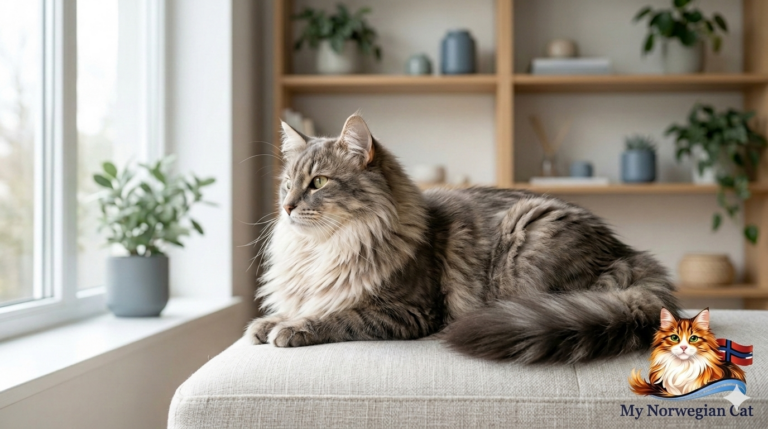
The breed is defined by three things: a distinctive double coat that is genuinely waterproof, a triangular head with a completely straight profile (no nose break), and a temperament shaped by centuries of working alongside humans in Norwegian farmsteads.
Quick breed profile:
| Attribute | Detail |
|---|---|
| Origin | Norway |
| FIFe classification | Category II (semi-longhair), code NFO |
| Weight | Males 4.5–9 kg · Females 3.6–8 kg |
| Lifespan | 14–16 years |
| Coat | Double-layered, semi-long, water-resistant |
| Recognition | FIFe (1977), TICA, CFA, GCCF |
| National status | Norway’s national cat since 1979 |
Physical Characteristics: Size, Coat and Appearance
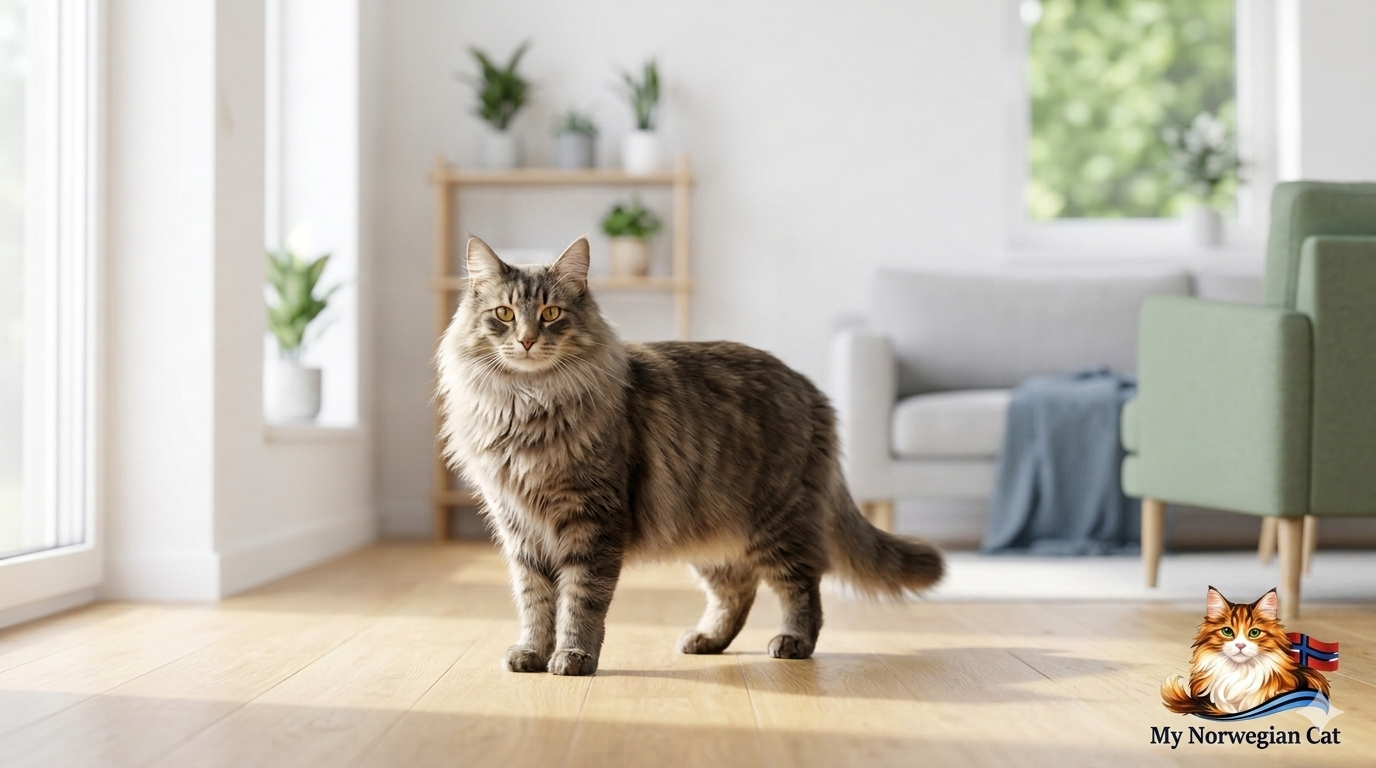
Norwegian Forest Cats are a large breed — but not in the way marketing photographs usually suggest. The size is real; the impression often comes from the coat rather than the body beneath it.
Build and size
Males typically reach 4.5–9 kg; females 3.6–8 kg. These are wide ranges that reflect genuine variation within the breed. An adult male NFC at 6 kg is within normal range — not small. At 8 kg he is impressive but not unusual. For detailed big norwegian forest cat weight milestones by age, see the size guide.
What distinguishes the NFC’s size from simply being a heavy cat is the body structure: a rectangular body with substantial bone density, a broad chest that develops gradually, and muscle mass that continues growing until age 4–5. A two-year-old male NFC may look complete but will continue adding muscle for another two to three years.
The coat
The NFC’s coat is not just long — it is structurally specialised. It has two distinct layers:
The undercoat is dense and woolly, trapping air for insulation. The topcoat consists of longer guard hairs coated with natural oils (sebum) that cause water to bead and run off the surface — the same principle as waterproof feathers on a seabird.
This is not a figure of speech. An NFC caught in rain remains functionally dry at the skin. Bathing one requires deliberately working water against the coat growth direction to penetrate the topcoat oil barrier.
The coat is seasonal: full and spectacular in winter (September–February), noticeably shorter after the spring moult (March–May). A summer-coat NFC can look like a different animal entirely.
The head and ear features
The head is the breed’s most distinctive physical feature and the most reliable way to distinguish an NFC from a Maine Coon or Siberian. FIFe requires an equilateral triangle head shape when viewed from the front, with a completely straight profile — forehead to nose, no break, no concavity. The ears are large and set high, with cat ear tufts (lynx tips) and prominent interior furnishings — adaptations that originally served to keep cold air and snow out of the ear canal in Norwegian winters.
Personality and Temperament
Norwegian Forest Cats are frequently described as dog-like — a description that is accurate but incomplete.
They are loyal, but selectively so. They choose their people and maintain those relationships consistently, following their person from room to room, greeting them specifically at the door, sleeping near them rather than with everyone equally. Strangers get observed before they get approached — the breed’s “assessment before engagement” approach is characteristic, not shyness.
They are affectionate, but on their terms. Most NFCs are proximity cats rather than lap cats: they want to be near you, not necessarily on you. Males are more reliably contact-seeking than females. Both sexes bond deeply with their chosen people and maintain those bonds throughout the cat’s life.
They are active, but not hyperactive. The hunting drive is real — wand toys get stalked with genuine focus, puzzle feeders get worked seriously — but the NFC has an off switch. They can sit in a window for hours, then switch to twenty minutes of intensive play, then settle again.
The dog-like qualities — greeting at the door, following through rooms, learning to fetch, responding specifically to their name — trace to centuries of working life in Norwegian farmsteads. These are engagement patterns developed over a millennium of close human proximity, not traits selectively bred for in the modern pedigree programme.
Owners frequently find what norwegian forest cat reddit communities describe as the most consistent surprise: the personality assessment period. For the first days or weeks in a new home, a new NFC watches. Then one day it decides. And from that point the affection is consistent and specific.
Norwegian Forest Cat History and Origins
The NFC’s history is ancient, almost interrupted, and ultimately the result of deliberate rescue.
The natural breed
The Norwegian Forest Cat is a landrace breed — meaning it developed through environmental selection rather than human design. Centuries of Scandinavian winters selected for waterproof coats, large bodies for thermal mass, and climbing ability for hunting in forested terrain. The result was a cat type so well-adapted to its environment that it survived largely unchanged across a millennium.
These cats worked in Norwegian farmsteads as mousers, traveled on viking norwegian forest longships as rodent control (archaeological evidence from Birka and other Viking-Age sites confirms this), and became sufficiently embedded in Norse culture to appear in the mythology. The 13th-century Prose Edda’s description of norwegian forest cat freya travelling in a chariot pulled by two large cats is widely attributed by Nordic folklorists to the Norwegian Forest Cat — the only large, strong domestic cat native to Scandinavia at the time.
Near-extinction and rescue
The Second World War nearly ended the breed. Cross-breeding with domestic shorthaired cats — which increased during the hardships of occupation — diluted the breed’s characteristics to the point where wild norwegian forest type cats were becoming rare. Post-war, a deliberate programme by the Norwegian Forest Cat Club rebuilt the breed from remaining pure-type cats.
FIFe recognition came in 1977 — late for a breed this ancient. King Olav V of Norway designated the NFC as Norway’s national cat in 1979. Today, the breed’s status and questions about are norwegian forest cats actually rare reflect this history: the breed is not endangered, but supply consistently falls short of global demand.
International spread
The breed’s first imports to the United States came in the 1980s. American popularity has grown consistently since, though the breed remains most densely concentrated in Scandinavia and France. In FIFe’s 2024 statistics, the NFC ranked 6th most popular breed globally with 4,105 registered kittens — 4.3% of all FIFe registrations.
Norwegian Forest Cat vs Maine Coon: Key Differences
The two breeds are superficially similar — large, semi-long-haired, cold-climate-adapted — and are frequently confused. The differences are real and consistent.
The definitive visual test: look at the profile. NFCs have a completely straight profile from forehead to nose (FIFe requires this). Maine Coons have a slight concavity — a visible nose break. This is reliably distinguishable in photographs and definitive in person.
Other consistent differences:
| Feature | Norwegian Forest Cat | Maine Coon |
|---|---|---|
| Profile | Perfectly straight | Slight concavity |
| Head shape | Equilateral triangle | More rectangular |
| Ears | High-set, lynx tips | Large, tufted, wider-set |
| Body | Rectangular, lean-muscled | Broader chest, heavier bone |
| Coat texture | Double, hydrophobic | Double, shaggy |
| GSD IV risk | NFC-only | None |
| HCM gene test | Not available (echo only) | Available (MyBPC3) |
The NFC is sometimes nicknamed the wegie cat in English-speaking cat communities — an anglicisation of “Norwegian” that became standard among enthusiasts in the 1990s.
Health and Lifespan
The NFC is a generally healthy breed with a typical lifespan of 14–16 years. Two conditions deserve specific attention from any prospective owner.
Glycogen Storage Disease Type IV (GSD IV)
GSD IV is documented only in Norwegian Forest Cats among all domestic cat breeds — it is NFC-exclusive. Caused by a mutation in the GBE1 gene, it affects glycogen metabolism. Kittens born with two copies of the mutation (GBE1/GBE1) typically die at birth or within the first five months.
The critical point: this is entirely preventable through DNA testing. PawPeds launched the official NFC breed health programme for GSD IV in October 2008. Responsible breeders test both parents; you can verify results at pawpeds.com. A cat with one copy of the mutation (N/GBE1) is a healthy carrier — no health impact to that cat.
Hypertrophic Cardiomyopathy (HCM)
HCM — thickening of the heart wall — is less prevalent in NFCs than in Maine Coons or Ragdolls, but the breed is not exempt. Unlike those breeds, there is no breed-specific DNA test for NFC HCM; monitoring relies on echocardiography. Annual cardiac screening is recommended for breeding cats from age 2; every 2–3 years for pets.
In March 2025, the FDA conditionally approved sirolimus (Felycin-CA1) for subclinical feline HCM — the first approved treatment for this condition. This changes the management conversation significantly for cats diagnosed at an early stage.
According to Cornell University’s Feline Health Center, HCM is the most common cardiac disease in cats broadly. For NFC owners, the combination of PawPeds health programme participation and regular echocardiography provides the most complete screening available.
Grooming and Care Requirements
The NFC’s coat is beautiful and demanding in equal measure. The honest grooming commitment:
- Daily (5 minutes): slicker brush through the coat, particularly behind ears and armpits where mats form first
- Weekly (15 minutes): wide-tooth comb through the full undercoat
- Monthly (30–45 minutes): bath if needed, nail trim, ear check
- Spring moult (6–8 weeks, March–May): daily intensive brushing minimum; mats can form within 48 hours without it
The spring moult surprises most new owners. The volume of shed fur is significant — enough to concern people who haven’t been warned. It is entirely normal. Daily brushing during this period keeps mats from forming and keeps furniture manageable.
Two tools are non-negotiable: a self-cleaning slicker brush for daily work, and a wide-tooth comb for weekly undercoat access. A deshedding tool (Furminator-style) is useful during the moult but should not be used year-round — it can damage guard hairs with overuse.
Norwegian Forest Cat Facts Worth Knowing
A few norwegian forest cat specifics that consistently surprise new owners and experienced breeders alike:
Maturation timeline. NFCs do not reach full adult size until 4–5 years. A 2-year-old male NFC may look complete but will continue adding muscle for another two to three years. Don’t assess adult size before age 3.
Climbing ability. NFCs can descend trees head-first — one of the very few domestic cats capable of this, due to rotating hind ankles. This is the physical basis for their supernatural reputation in Norse folklore.
The spring moult. After the winter coat sheds (typically March–May), an NFC can look like a completely different animal. This is expected and normal. The full winter coat returns by September.
The norwegian forest cat history and GSD IV. The breed is the only domestic cat in which Glycogen Storage Disease Type IV has been documented. This unique genetic risk is why PawPeds health testing matters — and why it’s the single most important question to ask any breeder.
Is a Norwegian Forest Cat Right for You?
The NFC is an excellent match for owners who want a loyal, engaged companion without constant demanding behaviour; families with children over 6; households with dogs when introduced properly; apartment dwellers who commit to vertical space and daily play; and first-time cat owners who research the breed thoroughly.
It is a poor match for: people with severe cat allergies (the breed is not hypoallergenic); owners away from home 12+ hours daily with no enrichment plan; people unwilling to commit to regular grooming; and people expecting a constantly lap-sitting, high-contact cat.
The small norwegian forest cat question comes up frequently — females at 3.6–5 kg are genuinely smaller than the photographs suggest. Both sexes are covered by the same care requirements and temperament profile.
How to Find a Norwegian Forest Cat
Demand significantly outpaces supply. Use TICA’s breeder search (tica.org/find-a-breeder) or FIFe’s member clubs (fifeweb.org). Every reputable breeder should provide: DNA test results for GSD IV (both parents), cardiac screening history, pedigree certificate, and a signed contract with health guarantee.
Prices: $800–$1,800 (USA, pet quality), $2,000–$3,500+ (show quality). Any cat offered under $400 with a pedigree claim warrants extreme caution.
For the cat show world perspective, the norwegian forest cat in competition provides another lens on what the breed standard actually means in practice — and why the straight profile distinction from the Maine Coon matters to judges.
[nfc_cta title=”Want the Complete Norwegian Forest Cat Owner’s Guide?” desc=”Everything from choosing a breeder to senior care — health testing, grooming schedules, nutrition and the questions every reputable breeder should be happy to answer.” url=”/go/checklist/” btn=”Download Free →”]
[nfc_lead]
Frequently Asked Questions
What is a Norwegian Forest Cat?
A Norwegian Forest Cat is a large, semi-longhaired domestic cat native to Norway, classified by FIFe under the code NFO. It has a waterproof double coat, a distinctive triangular head with a straight profile, and a temperament shaped by centuries as a working farmstead cat.
Are Norwegian Forest Cats friendly?
Yes — selectively and consistently. NFCs form deep bonds with their chosen people and are reliably affectionate within those relationships. They observe before engaging with strangers, which is breed-characteristic rather than unfriendliness. Males are typically more openly affectionate; females more selective.
How big do Norwegian Forest Cats get?
Males: 4.5–9 kg. Females: 3.6–8 kg. They do not reach full adult size until 4–5 years of age — unusually slow even among large breeds. Assessment before age 3 is unreliable.
What is the difference between a Norwegian Forest Cat and a Maine Coon?
The most reliable visual distinction is the profile: NFCs have a completely straight profile (FIFe standard requirement); Maine Coons have a slight nose concavity. NFCs also have a more triangular head shape. Genetically, GSD IV is NFC-exclusive — no Maine Coon carries this condition.
Are Norwegian Forest Cats rare?
Not by registry numbers (6th most popular FIFe breed in 2024), but rare enough in practice that waitlists of 6–18 months are standard. Approximately 4,100 kittens registered globally per year creates a significant supply/demand gap against search volumes exceeding 500,000 monthly.
How long do Norwegian Forest Cats live?
14–16 years with proper care. Health-tested stock from screened breeding programmes — GSD IV DNA-clear, HCM-screened — consistently reaches the upper end of this range.